
Carol Stream Address History Sources
The best starting record depends on the period. Current parcel and transfer pages point toward recent owners. Recorder research extends through older land instruments, while community directories can add occupants who did not own the property. Census and archival material take over when a modern Carol Stream address did not yet exist.
| Source | Years covered | Where held | What it shows |
|---|---|---|---|
| Property research | Current and recorded transfer history | DuPage property portal | PIN, owner fields, sales and legal description |
| Recorder research | 1839 to present | DuPage Recorder | Deeds, plats, easements and parties |
| Computer name index | 1961 to present | Recorder portal or terminals | Grantor and grantee entries |
| Address index | 1995 to present | Recorder portal | Instruments keyed by street address |
| Community directories | 1992 to 2019 identified | Carol Stream Historical Society | Potential names, addresses and phone entries |
| Federal census | Through 1950 publicly released | NARA and research databases | Households and relationships |
Not every directory volume is known to be complete. Verify its scope and access terms before treating an entry as evidence of occupancy. For a pre-1959 address, also search Gretna, Tall Trees, township, railroad, church, and county labels.
Track Carol Stream Owners Backward
Start with the DuPage property portal. Copy the current PIN, owner-related fields, legal description, transfer date, and recorded document number. The parcel record is a tax and assessment trail, not a title opinion, but it supplies the keys needed at the Recorder.
- Find the current parcel by exact address and save its PIN.
- Open the current purchase deed by document number or buyer name.
- Read the seller, legal description, recording date, and prior reference.
- Search that seller as a grantee to locate an earlier purchase.
- Repeat until the computer index ends, then ask Recorder research staff for older books or indexes.
The Recorder search accepts names, bank or trust details, subdivisions, streets, PINs, document numbers, groups, and document types. During inspection the system was down, so use public terminals at 421 N. County Farm Road, call (630) 407-5401, or coordinate by phone or mail. A known document number may also work in the book-and-page register.
- Grantor
- The party conveying an interest in a recorded instrument.
- Grantee
- The party receiving that interest.
- Chain of title
- The linked sequence of recorded transfers for the same land.
- Legal description
- The formal land description that can survive street-name or number changes.
Carol Stream Book and Page Clues
A document number can be more stable than a street address. The Recorder's book-and-page register accepts a numeric document number and may return the document number, book, page, and type. It is an alternate route when the main index is unavailable, not a substitute for reading the instrument.
See the official register at the DuPage Recorder source.
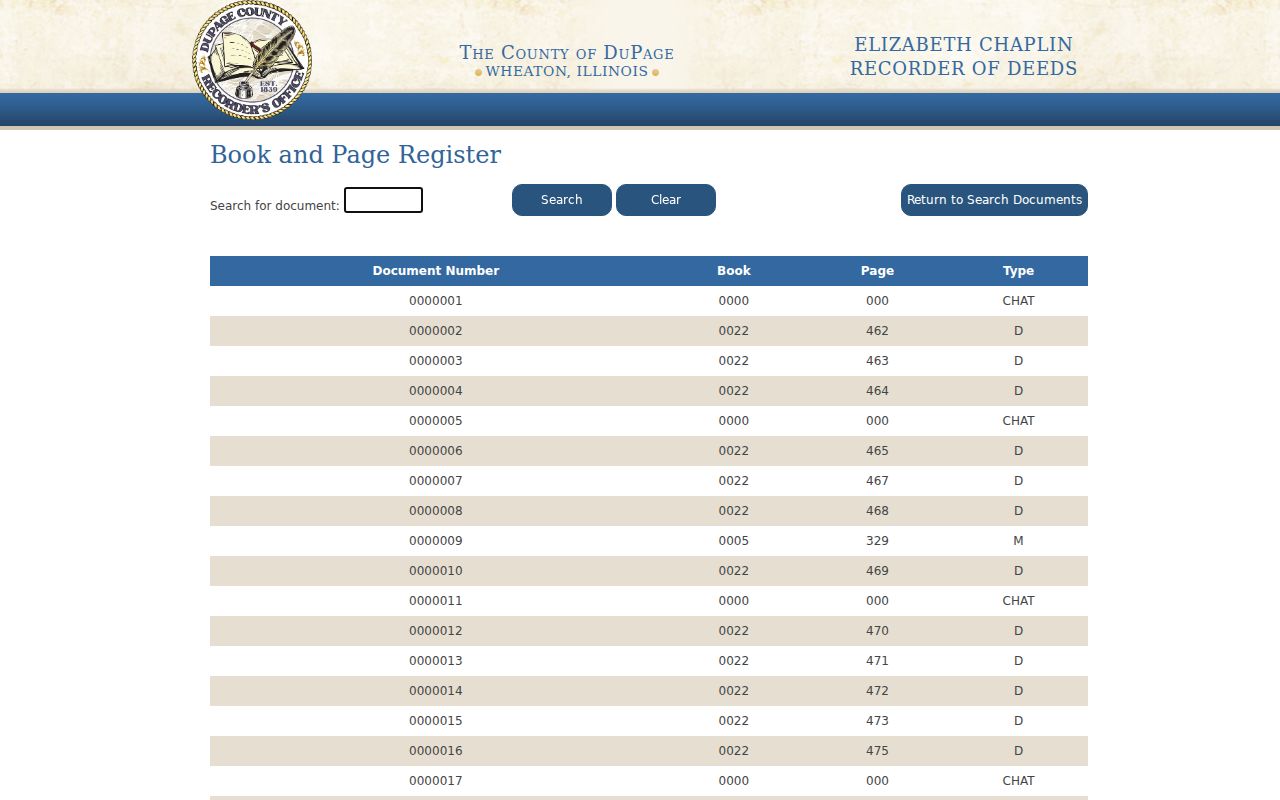
The captured register shows the compact fields available when a deed reference is already known.
A plat may carry the trail farther than a name search. It can show lot numbers, subdivision names, streets, dedications, and easements. Pair it with current GIS geometry and Village engineering records.
Read Carol Stream Transfer History
A DuPage property sales detail can show the PIN, county number, neighborhood, tax year, sale date, price, document type, document number, grantor, grantee, recording date, and owner or billing context. Keep those fields distinct. The sale date and recording date are not always the same, assessed value is not sale price, and the displayed owner field can reflect a later update.
The official sample sales-history page demonstrates the layout.
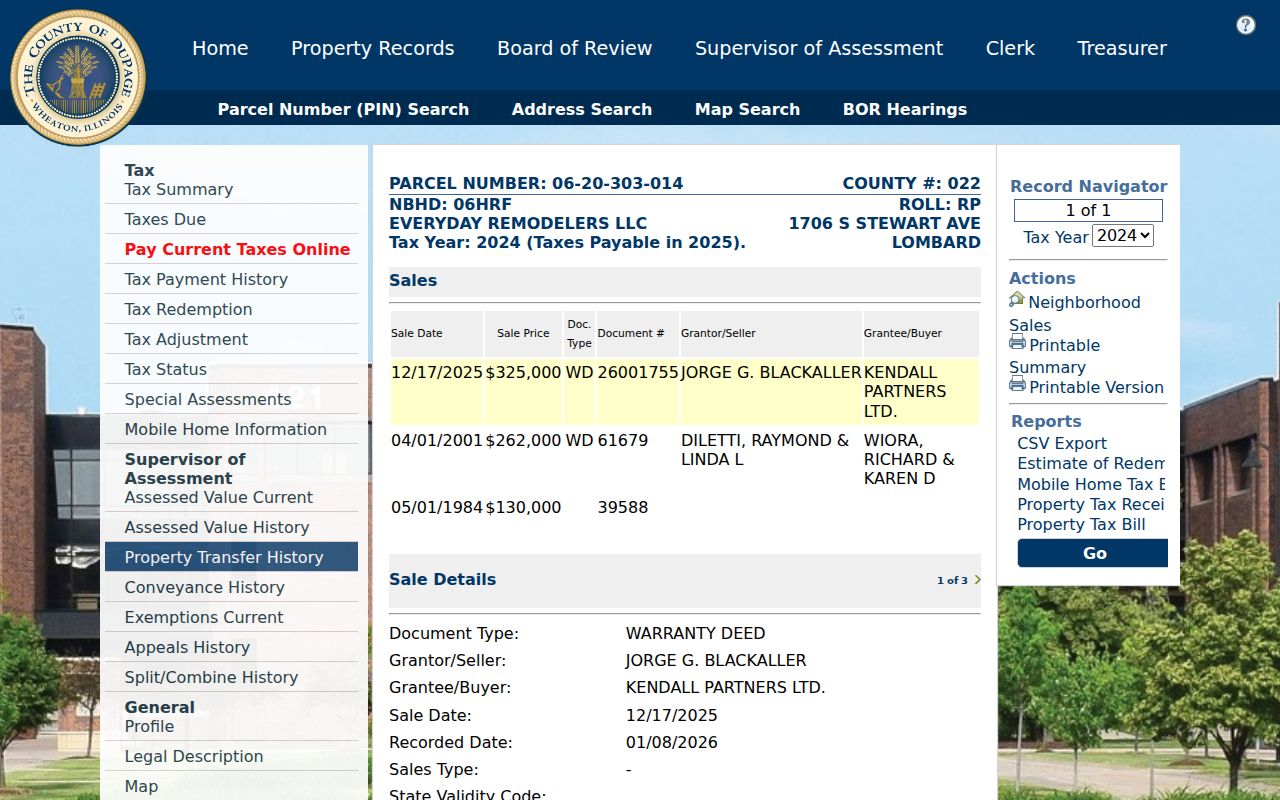
The screenshot helps identify the fields to copy before walking the deed chain backward.
Do not assume every grantor occupied the property. Trusts, companies, estates, and other parties may enter the legal trail without appearing in the home's daily life.
Carol Stream Past Household Evidence
Deeds identify title parties, while directories and census schedules can supply the household layer. The Carol Stream Historical Society finding aid identifies community directory material from 1992 through 2019. Confirm each volume's arrangement, completeness, and viewing terms. A criss-cross volume, arranged by address, is especially useful when the surname is unknown.
Pair a directory year with the nearest public census year, then compare names, ages, relationships, occupation notes, and address sequence. Census records are released under a 72-year rule, making 1950 the latest public federal schedule as of this research. A modern street may not exist in that schedule, so use old maps, subdivision plats, enumeration districts, and nearby landmarks.
- Write the address exactly as printed in each directory.
- Search the same surname in the nearest census schedule.
- Check adjacent households and street order for geographic context.
- Compare the legal parcel with a dated plat or map.
- Record conflicts instead of silently combining two people.
The collections themselves, including how entries are organized, belong on the Carol Stream city directory page. For previous residents, the goal is to connect one dated address entry to the next.
Carol Stream Archives Fill Gaps
The Historical Society finding aid spans 1834 to 2024, with most material dating from 1959 to 2024. It describes 14 series and about 14 linear feet of files. The collection includes local people and places, maps, directories, photographs, oral histories, civic material, and news clippings. Access is by appointment, and reproduction or quotation terms should be checked.
The DuPage County Historical Museum adds photographs, maps, archives, and research assistance. Its online database is only part of the collection, so staff help may uncover an uncataloged or undigitized map.
View the museum's public collection route at the official collections page.
The collection screen points beyond parcel records to dated images and maps that can identify how a place changed.
Earlier Names Around Carol Stream
The Village incorporated in 1959. Before that date, records for the modern area may sit under Gretna, Tall Trees, a township, the Chicago Great Western Railway stop, St Stephen Catholic Church, or DuPage County. These are search terms, not interchangeable names for the present municipality.
Anning S. Ransom farmed in the area around 1840. Daniel Kelley bought about 1,400 acres in 1844 at Tall Trees, and Gretna later developed near the railway. This chronology explains why a search limited to “Carol Stream” can miss an early household or land record. Start with the older label, then use a plat, deed, county map, or Village history source to connect it to the modern address.
Note: A later catalog may apply Carol Stream to older material for convenience; verify the original locality printed on the record.
Confirm Carol Stream Resident Endpoints
Obituaries, cemetery records, probate cases, vital indexes, and estate deeds can explain when a past resident left the trail. An obituary is a published account, not a land record. Probate files may name heirs or property but can be sealed or partly restricted. Vital copies have event-specific eligibility rules, while older genealogy copies use separate age thresholds and are stamped as uncertified.
Search the DuPage IRAD holdings for older county and local-government series. The Illinois Regional Archives Depository route includes marriage, naturalization, school, board, and other records, but holdings vary by series and date. Ask for the record series, person, place, and approximate year.
Limits on Carol Stream Past Residents
Previous residents are not established by one field. A billing name may point to a mailing contact. A deed party may be a trust or estate. A directory can omit a household, and a census may preserve an old spelling. Treat “not found online” and “not public” as separate outcomes. Office terminals, mail requests, archival appointments, and staff research can bridge an online gap.
Lawful use. Research Carol Stream past residents for house history, genealogy, estates, and personal curiosity. Never use a record trail to track, harass, intimidate, or harm a living person.
Finish with a source log. Record the URL or office, lookup date, address form, PIN, directory or census year, document number, and any conflict. That audit trail keeps an appealing house story from becoming an unsupported claim.